



Your Website is Leaking Revenue: 5 Signs It’s Time for a Redesign
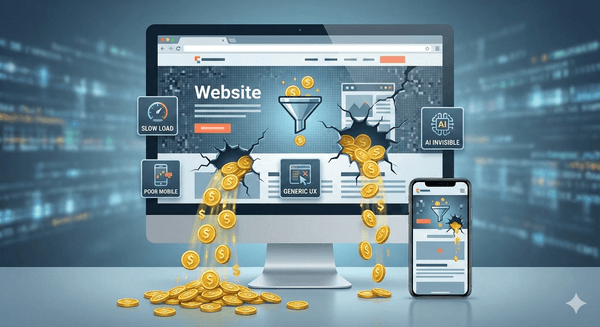
In the digital landscape of 2026, your website is no longer just a digital “brochure”—it is your most active salesperson. However, if your site was built even three years ago, it may be actively working against your bottom line.
With the rise of AI-driven search and “Agentic UX” (interfaces that predict user intent), the gap between high-performing sites and those “leaking” revenue has never been wider. If you notice any of the following five signs, your website is likely costing you more in lost opportunities than a redesign would cost to implement.
1. The “Speed Tax” is Slashing Your Conversions
In 2026, user patience is measured in milliseconds, not seconds. Google’s transition to Interaction to Next Paint (INP) as a core ranking factor means that “sluggish” feeling when a user clicks a button is now a direct penalty to your visibility and revenue.
- The Reality: 53% of mobile users will abandon a page if it takes longer than 3 seconds to load.
- The Cost: Research shows that a 1-second delay in page load can reduce conversions by 7%. For a site generating $10,000/month, that is a $700 “tax” every month for being slow.
| Load Time | Conversion Impact | Revenue Risk |
|---|---|---|
| < 2 Seconds | Optimal | High Retention |
| ~ 3 Seconds | -7% | Moderate Leak |
| 5+ Seconds | -30% or more | Critical Loss |
2. Your Mobile Experience is a “Lite” Version of Desktop
If your mobile site feels like a cramped, stripped-down version of your desktop experience, you are losing the majority of your audience. With mobile devices accounting for over 60% of web traffic, a “responsive” site that simply stacks elements isn’t enough anymore.
Signs of a leak:
- Users have to “pinch and zoom” to read text.
- “Rage clicks” occur because buttons (touch targets) are too close together.
- The checkout or contact form is cumbersome on a smartphone.
3. You Lack AI-Powered Personalization
The “one-size-fits-all” website is officially dead. Modern users expect Agentic UX—a site that adapts based on their behavior. If a returning customer sees the same “New Here?” hero banner as a first-time visitor, your site is failing to move them down the funnel.
Revenue Leak: Static websites have a significantly higher “bounce rate” because they fail to deliver immediate, relevant value. Redesigning for dynamic content (showing different CTAs based on the user’s location or previous visits) can increase conversion rates by up to 20%.
4. Your Visuals Erode Trust in 0.05 Seconds
First impressions are literal. Users form an opinion about your brand’s credibility within 0.05 seconds of your page loading.
Red Flags for 2026:
- Generic AI Art & Stock Photos: Users are now “AI-aware” and can spot uncanny, generic imagery instantly. It signals a lack of authenticity.
- Lack of Video Social Proof: In 2026, text testimonials are easily faked. High-converting sites now use short-form video testimonials to build “Human-to-Human” (H2H) trust.
- Outdated Security: If your site doesn’t have an up-to-date SSL or displays “Not Secure” warnings, visitors will leave before they even see your offer.
5. You are “Invisible” to AI Assistants
The way people find information has shifted from “keywords” to “conversations.” If your website structure isn’t optimized for Voice and AI Search (SGE/Gemini/Siri), you aren’t just losing SEO rankings—you are becoming invisible to the tools your customers use to find solutions.
Is your site AI-ready?
- Structured Data: Does your site use schema markup so AI agents can “read” your prices, services, and reviews?
- Conversational Content: Do you have FAQ sections that answer specific, natural-language questions?
- Authority (E-E-A-T): Does your site clearly demonstrate Experience, Expertise, Authoritativeness, and Trust? If not, AI search engines will stop recommending you.
Is it time to plug the leaks?
A redesign isn’t just about a “fresh coat of paint.” It’s a strategic overhaul of your business’s primary revenue engine to meet the standards of 2026.